Gold, Remembrance and Gallop: The Gold Coin of the Golden Horse Amazons Series in the Context of the Steigenberger Family
An unusual intersection between numismatics and horse racing
At first glance, the connection between the Steigenberger family, a gold coin and international horse racing might seem like a marginal topic. For readers with an interest in numismatics, however, the case is noteworthy because it demonstrates how a modern bullion coin can take on significance within a context that is at once ceremonial, commemorative and steeped in sporting history.
At the centre of it all is the Golden Horse Amazons Series, a racing series linked to women’s horse racing. It is within this framework that the gold coin acquires its symbolic significance. The numismatic appeal arises not from a special strike, but from the deliberate use of a regular gold coin as a decoration in memory of Albert Steigenberger.
The connection to the Steigenberger family and the racing series
In the context of horse racing, the name Steigenberger is primarily associated with Albert Steigenberger, who played a prominent role as an owner and patron in German and international flat racing. Following his death, the Albert Steigenberger Memorial Race was established to create a commemorative framework that underscores his significance to the sport.
At the same time, the Golden Horse Amazons Series is an expression of a philosophy of support that arose from a personal passion for racing. Carl-Philip Count zu Solms-Wildenfels has been actively involved in Iffezheim for many years. From this long-standing support, the idea developed in collaboration with Baden Galopp and Vincent Steigenberger not merely to sponsor individual races, but to create a permanent format specifically designed to strengthen young talent and women in the sport.
Carl-Philip Graf zu Solms-Wildenfels describes this journey as a progression from initial support for individual races to a genuine passion, which ultimately led to the creation of the quite extensive series. Underlying this is the conviction to invest in the sport itself and in the people who sustain it.
For Vincent Steigenberger, the series also has a very personal dimension. The opening race on 7 June 2026 will be held as the Albert Steigenberger Memorial Race, commemorating his father, who was closely associated with equestrian sport. This gives the series a dual character: it is both a promotional project and a personal memorial.
Vincent Steigenberger’s involvement also fits into this context, as he continues the family’s connection to the racing series. The link is therefore clear: the focus is not on a coin issued by the family, but on the integration of a gold coin into a racing series that visibly honours the memory of Albert Steigenberger.
Series overview
The Golden Horse Amazons Series comprises three races for female jockeys, which will be held at all Iffezheim meetings in the year 2026. The series is open to female professional and amateur jockeys. It follows an overall points system in which placings are accumulated.
The first race takes place on Sunday, 7 June 2026, as part of the Spring Meeting and will be held as the Albert Steigenberger Memorial Race. The second race follows on Saturday, 5 September 2026, during the Grand Week. The third race is scheduled for Sunday, 18 October 2026, at the Sales & Racing Festival.
Is this a “Steigenberger gold coin”?
From a numismatic perspective, precision is important here. To the best of our knowledge, there is no gold coin specifically minted by the Steigenberger family on the theme of horse racing. There is therefore no officially documented commemorative issue, no known private issue and no catalogued emission that could be directly described as a “Steigenberger gold coin”.
The term is therefore only accurate in a broader, contextual sense. It refers to a gold coin that is used as a prestigious prize as part of the Golden Horse Amazons Series and is clearly associated with the family through the Albert Steigenberger Memorial Race.
The coin itself: bullion rather than a special strike
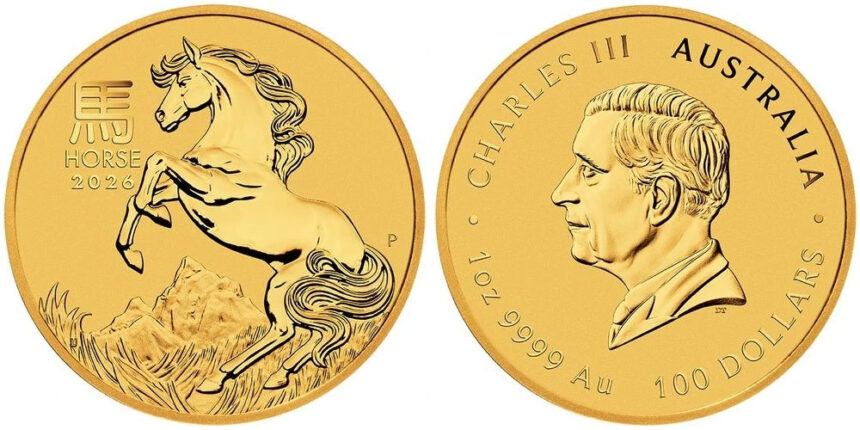
As the main prize in the overall standings, the most successful female jockey in the series receives a 1-ounce gold coin from the Perth Mint’s Lunar Series III, dated 2026 – Year of the Horse. The coin is made of 999.9 fine gold and has been estimated in the series’ promotional materials to have a market value of around 4,200 euros. This is particularly appealing to readers with an interest in numismatics, as it places an internationally renowned bullion issue within a very specific sporting and commemorative context.
The obverse of the coin is struck with a rearing horse with a flowing mane and taut muscles. A mountain rises in the background; this is accompanied by the Chinese characters for ‘horse’ and the inscription HORSE 2026. Thus, the coin is not only thematically appropriate but also fits convincingly into the context of horse racing from an iconographic perspective.
The reverse side bears the portrait of King Charles III, as well as the details AUSTRALIA, 1 oz 9999 Au and the denomination of 100 DOLLARS. Within the Lunar Series III, this is the seventh motif of the current twelve-year cycle.
The gold coin is complemented by a Silver variant featuring the same motif, each of which is to be awarded to the winner of the individual race. This creates a small, formally cohesive prize structure within the series, with gold for the overall standings and Silver for the daily victories.
The gold coin mentioned in this context is therefore not an individual medal or a personalised race prize coin, but a standard 1-ounce gold coin. It is precisely this point that is crucial for collectors.
In numismatic terms, this means:
The coin derives its primary market value initially from metal content, minting quality, the attractiveness of the design and market demand as a standard issue. Its additional appeal does not stem from an official special status, but from its use as a trophy. This second layer of meaning is interesting from a cultural and collector-historical perspective, but does not replace an independent numismatic typology.
Why the case is nevertheless interesting
Particularly for a numismatically educated audience, the value of the subject lies in the grey area between coin, decoration and commemorative culture. Such constellations are not new. Time and again, regular coins made of bullion are transferred into a ceremonial context and thereby acquire an additional provenance.
This raises several questions:
How does the perception of a standardised bullion coin change when it is awarded as the prize in a commemorative race? When does a normal minted product become a collectable object with a history of its own? And is a documented connection to an event sufficient to justify a special market appeal or provenance premium at a later date?
In the present case, this development has not yet been observed. As things stand, there is no established auction history, no independent cataloguing and no reliable collector’s premium that would have arisen solely from the Steigenberger connection.
Provenance as a potential collector’s factor
Should a specific, awarded specimen from the racing series appear on the market at a later date and its provenance be fully documented, the appraisal could change. In that case, it would not be the coin as a type that is rare, but the individual piece with its event-related provenance that is remarkable.
This is a familiar phenomenon to numismatists. The historical significance of an object often arises less from the way it was struck than from its history: previous owners, special occasions, donations, dedications or award contexts can transform an otherwise run-of-the-mill piece into an object of significantly greater appeal to collectors.
In the case of the Golden Horse Amazons Series, however, this would require precise documentation, such as certificates, photographs of the award ceremony, engravings, cases or official organiser’s records.
Between sporting history and numismatics
The connection between horse racing and numismatics is traditionally characterised more by medals, honorary prizes and commemorative items than by classic coin issues. This is precisely why this case is so fascinating: it demonstrates how strongly numismatic interest can also focus on objects that lie outside the scope of conventional catalogue thinking.
The gold coin from the Golden Horse Amazons Series is less a new chapter in coinage than an example of how context creates meaning. For collectors interested in provenance, sporting history and cultural-historical intersections, this presents a thoroughly compelling subject.
It is precisely here that the actual numismatic point of this case lies: according to current knowledge, the so-called ‘Steigenberger gold coin for horse racing’ is not a standalone issue, but a gold coin used as a prize in the context of the Golden Horse Amazons Series. Its special significance stems from the commemoration of Albert Steigenberger, from the family connection to horse racing, and from the question of whether individual specimens awarded will gain greater collector’s appeal in future due to their documented provenance.