Louis XIII, Dix Louis 1640: From the Royal Mint to a pendant and back again
This 10 Louis d’or with a laureate head and draped bust from Paris, 1640, under Louis XIII (1610–1643), is far more than just a large gold coin. It is an object with a history. That is precisely what makes this coin so fascinating on Sixbid today: It tells not only of royal representation in 17th-century France, but also of a later private use – and of its transformation back into the coin as we see it today.
Even from a numismatic perspective, the piece belongs in the top tier. The current description on Sixbid lists the legend on the obvers as LVDOVICVS. XIII. D. G. FRANC. ET. NAV. REX. on the obverse, as well as the laureate, draped bust of the king facing right, with the cipher of year 1640 below. The revers bears the legend CHRISTVS. REGNAT. VINCIT. ET. IMPERAT. and features a cross composition of eight Ls, each with a crown on its arms, with an A in a circle at the centre and four lilies radiating outwards from the centre. The edge is today described as tranche lisse, i.e. level and smooth. The coin is referenced in Droulers 13, Duplessy 1293, Fr. 405 and Gadoury 63. The current weight is 66.46 g.
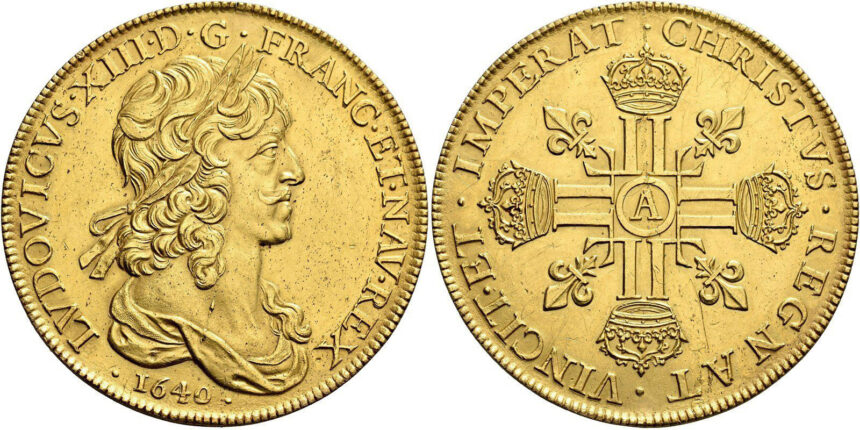
This specimen thus belongs to a category that stands out even amongst large gold coins. It is no coincidence that the current description hails it as “The largest gold coin in the history of France” and as “A jewel of European numismatics”. That sounds grand – and it certainly is. A 10 Louis from 1640 is not a piece to be viewed casually. It demands attention, and it gets it.
It is precisely this impact that forms part of the piece’s appeal. Such large gold pieces served not merely as a means of payment. They conveyed sovereignty, prestige and symbolism. The design is correspondingly clear: the king with a laurel wreath and drapery, in a form that embodies sovereignty, dignity and classical representation; on the revers, a strictly composed cross formed of L’s, crowned and flanked by lilies. This is numismatic art that does not rely on restraint, but on impact.
Yet it is precisely this specimen that fascinates not only because of its size or its iconographic programme. What makes it truly special is its documented transformation over the centuries. Originally, the coin was struck in 1640 as a representative royal gold piece. Later, in the 19th century, it was reworked and used as a pendant or wedding medal. An earlier catalogue entry noted that an eyelet had been fitted and an engraving added to the edge:
“Barthélémy Lecarpentier married on 30 November 1847 to Amélie Brunet”
Thus, a monumental gold coin became a personal memento. For a moment, the grand stage of the monarchy took a back seat to a private story. Instead of merely displaying royal self-promotion, the piece became part of a human memory – presumably relating to the wedding of Barthélémy Lecarpentier and Amélie Brunet on 30 November 1847. It cannot be said with certainty who exactly commissioned the alteration or who gave the coin as a gift. One thing is certain, however: the piece was temporarily transformed from a numismatic object into a personal, wearable item.
And this is precisely where the history of this coin becomes particularly fascinating, for the story does not end with the pendant. The alteration was later reversed. The current Sixbid description refers to “Traces of restoration on the edge”. This brief sentence is of great numismatic interest because it marks the third stage in the piece’s life: from coin to pendant and back to coin. The eyelet was omitted, the alterations were restored, and yet the intermediate phase has not been erased. It remains as a trace on the edge and as a documented part of the object’s history.
It is precisely this that makes this specimen so evocative. It is not only rare, but also legible. First, a royal prestige object of the 17th century. Then a personal pendant serving as a memento in the 19th century. And finally, once again, a coin of great significance to collectors, whose earlier repurposing is still traceable. Many coins are historically valuable. A select few also carry their history in the form of tangible transformations. This piece clearly belongs to the second category.
The provenance also underscores the lot’s exceptional status. It is stated to have come from a Japanese family collection and to have been previously auctioned at Sabine Bourgey, Paris 1995, Lot 34, with an estimate at the time of FF 150,000. Together with its current classification as extremely rare and extremely fine, this paints a picture of an object that is impressive not only for its type, rarity and gold weight, but also for its documented journey across countries, generations and contexts of use.
This very coin is currently up for auction on Sixbid: as lot 162 of Hess Divo’s Auction 344. Pre-bids can be placed until 17 June 2026 at 14:00. The auction begins on 17 June 2026 at 15:00 and will take place at the Hotel Schweizerhof, Bahnhofplatz 7, Zurich.
Anyone interested in French gold coins, masterpieces of European numismatics and objects with a genuine history should not view this lot merely as a rare large gold coin. This Dix Louis from 1640 is a specimen that exemplifies how a numismatic masterpiece can take on new meanings over the centuries without losing its aura. It is precisely this that makes it so fascinating: it is at once a monument, a memento and a recovered coin.